
Business funding document checklist
Prepare the business loan documents lenders may request, from bank statements and financials to debt schedules, ownership records, and product specific evidence.
The short answer
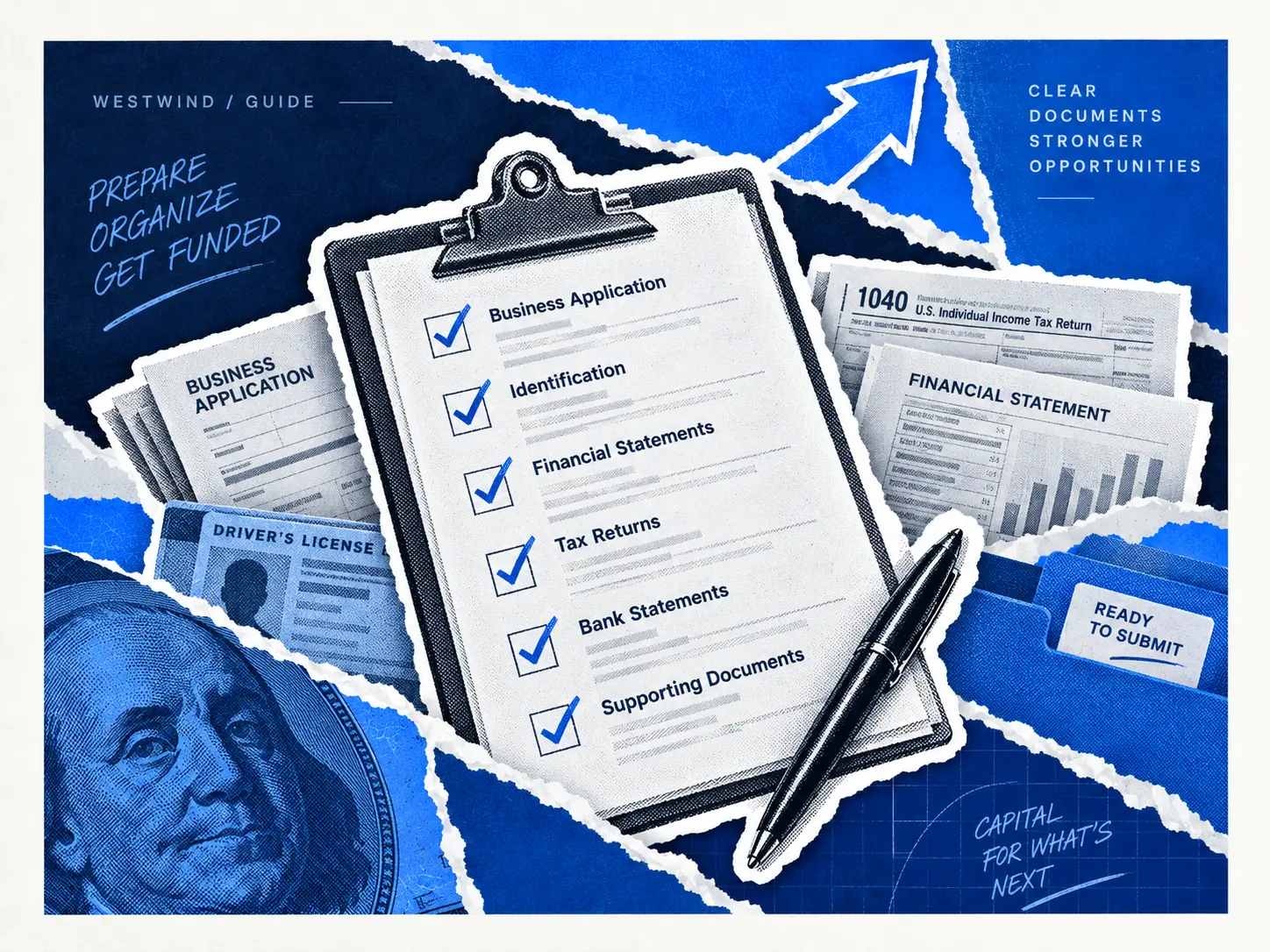
A business funding document checklist should cover ownership, financial performance, bank activity, existing obligations, and the purpose of the request. The exact documents depend on the lender and product. Preparing a consistent file reduces avoidable questions and helps a provider assess whether the business can support the proposed financing.
Key takeaways
- Start with the provider’s current checklist and the requirements of the specific financing structure.
- Reconcile bank statements, financial statements, debt schedules, and supporting records.
- Use consistent dates, readable filenames, and the agreed secure submission process.
The business context
Ask for the provider's current checklist before collecting sensitive information. A short term facility may begin with a smaller package than an acquisition loan or property transaction. Additional documents can still be requested during underwriting or before funds are released.
Prepare the core application file
| Document or information | What it helps establish |
|---|---|
| Legal business name and formation records | Which entity is applying and who can sign |
| EIN and relevant registrations or licenses | Identity and authority to operate |
| Ownership breakdown and requested identification | Owners and parties subject to review |
| Complete business bank statements | Actual account activity and cash patterns |
| Current profit and loss statement | Revenue, expenses, and operating performance |
| Current balance sheet | Assets, liabilities, and owner equity |
| Tax returns when requested | Filed historical financial information |
| Business debt schedule | Existing balances and payment commitments |
| Use of funds and requested amount | The purpose and size of the transaction |
| Cash flow forecast with assumptions | How the proposed payment will be supported |
Lender checklists commonly request financial statements and business information, though the scope varies. Chase's application guide and the FDIC's financing education materials both describe financial records as part of the review.[1], [2]
Do not infer that every row is required for every product. Ask which period each statement should cover, how recent it must be, and whether the lender requires accountant prepared records or accepts management accounts.
Make the financial documents agree
Reconcile the balance sheet to its supporting schedules. The accounts receivable total should agree with the aging report after consistent treatment of credits and other adjustments. Loan balances should tie to statements or be accompanied by an explanation of timing differences.
Bank deposits may differ from reported sales because of customer payment timing, processor deductions, transfers, or financing proceeds. Explain the bridge rather than editing records to produce a superficial match. Our guide to business bank statement analysis shows how those differences arise.
Use consistent reporting dates. A December balance sheet, April receivable aging, and August debt schedule describe different business positions. If a provider needs several dates, label them clearly and show the intervening changes.
Build a complete debt schedule
For each obligation, list the provider, original amount, current balance or purchased amount remaining, current payoff if available, payment amount, payment frequency, maturity or estimated duration, and any pledged collateral. Include business credit cards, equipment agreements, advances, and obligations paid from other accounts when applicable.
Mark which debts will remain after funding. If a new transaction refinances an old one, include the payoff statement and its expiration date. The new lender should be able to calculate the combined post closing payment burden without reconstructing it from unfamiliar bank descriptions.
An illustrative entry might read: equipment loan, $80,000 original amount, $52,000 current balance, $1,900 monthly payment, equipment security, 30 payments remaining. If a statement provides a different payoff, list both and explain accrued interest or other differences.
Add evidence for the product you need
Invoice factoring or receivables finance
Prepare a current receivable aging, customer list, sample invoices, customer contracts where requested, and delivery or acceptance evidence. Identify disputes, credits, existing assignments, and liens. The accounts receivable aging guide explains how to make that report useful.
Equipment financing
Provide a detailed supplier quote, equipment description, new or used status, serial numbers when available, delivery schedule, installation costs, and requested deposit. A lender may also ask how the equipment will improve operations and support repayment.[4]
SBA financing and business acquisitions
Expect the package to follow the program and transaction. This may include lender supplied SBA forms, ownership details, personal financial information, business plans, projections, purchase agreements, leases, valuations, or other closing evidence. SBA states that 7(a) application requirements vary by loan size and processing method.[3]
Use the lender's current forms. Do not rely on a saved checklist from an earlier transaction, particularly for ownership eligibility or acquisition requirements. Review the SBA financing guide for program selection and preparation.
Property related funding
Depending on the structure, a lender may need property financials, leases, a rent roll, purchase documents, insurance information, valuation, and environmental or title work. Ask which third party reports must be ordered through an approved process before spending money on them.
Organize the file so another person can use it
Create folders for company records, financials, bank statements, existing debt, and the proposed transaction. Use readable filenames that include the entity and reporting period. Keep original files separate from explanatory schedules.
For example, a statement labeled BusinessName_Bank_2026_09.pdf is easier to place than scan_final_new2.pdf. For a group of entities, use separate folders and an ownership chart so reviewers can distinguish the borrower from affiliates.
Track requested, provided, and outstanding items in a simple list. Assign one person to update the file so multiple versions of the same balance sheet do not circulate without explanation.
Check the file before submission
Confirm that bank statements are complete, dates are consistent, material discrepancies have explanations, and all required signatures are present. Check that the proposed amount matches the use of funds and that the forecast includes the new financing payments.
Ask how documents will be shared, who will receive them, and whether submitting an application authorizes credit checks or distribution to other providers. Use the agreed secure channel; never send banking passwords as part of a document package.
Common questions about funding documents
How many months of bank statements do I need?
The provider sets the requirement. Some begin with a few recent months; others need a longer period to assess seasonality or the transaction. Obtain the exact date range and include every requested account.
Do all business loans require tax returns?
No universal checklist applies. Some products use a limited initial file, while others require business and personal returns. A request for fewer documents does not establish that the financing is affordable or suitable.
What if my accounts are not up to date?
Tell the advisor what is available and arrange to update material records. Label management estimates honestly. An accountant can help reconcile gaps; an unexplained mismatch can delay review or affect confidence in the application.
Turn the checklist into a clear funding request
Use how to prepare for business funding to connect the documents to the amount, purpose, and repayment plan. A Westwind funding advisor can help identify the package a prospective provider needs and explain outstanding requests.
Sources and review
This guide addresses US business financing. Definitions and program details draw on the cited sources. Worked examples are hypothetical teaching illustrations, not customer case studies or financing offers.
- Small business loan application checklist
Chase for BusinessAccessed
One lender’s application checklist; actual requirements vary by product and transaction.
- Money Smart module 5 small business financing
Federal Deposit Insurance CorporationAccessed
FDIC small-business financing education concerning financial records and repayment ability.
- 7(a) loans
US Small Business AdministrationAccessed
Official overview of 7(a) uses, eligibility, limits, and application requirements.
- How to apply for business equipment financing
Chase for BusinessAccessed
One lender’s equipment-financing and application guidance; not a universal qualification standard.
Review notes and methodology
Assumptions
- Worked examples use US dollars and the assumptions stated beside each calculation.
- Example amounts, fees, and payment schedules are illustrative inputs, not quoted market terms.
Limits of the evidence
- Eligibility, pricing, and obligations vary by provider, product, jurisdiction, and agreement.
- Program rules can change. Confirm current requirements for the proposed transaction.
The site owner requested deployment of this complete guide on October 9, 2026. Source references, calculations, and internal links were checked during preparation. A named financial reviewer has not yet been recorded.
Westwind Capital is a financing intermediary. Providers determine eligibility, approval, pricing, and final terms.
Educational information, not individualized financial, legal, tax or accounting advice. Examples are not financing offers. Any actual terms and availability depend on the provider’s review and the relevant agreements.