
How lenders analyze business bank statements
See how lenders review deposits, daily balances, debt payments, and unusual transactions in business bank statements, with a clear worked example.
The short answer
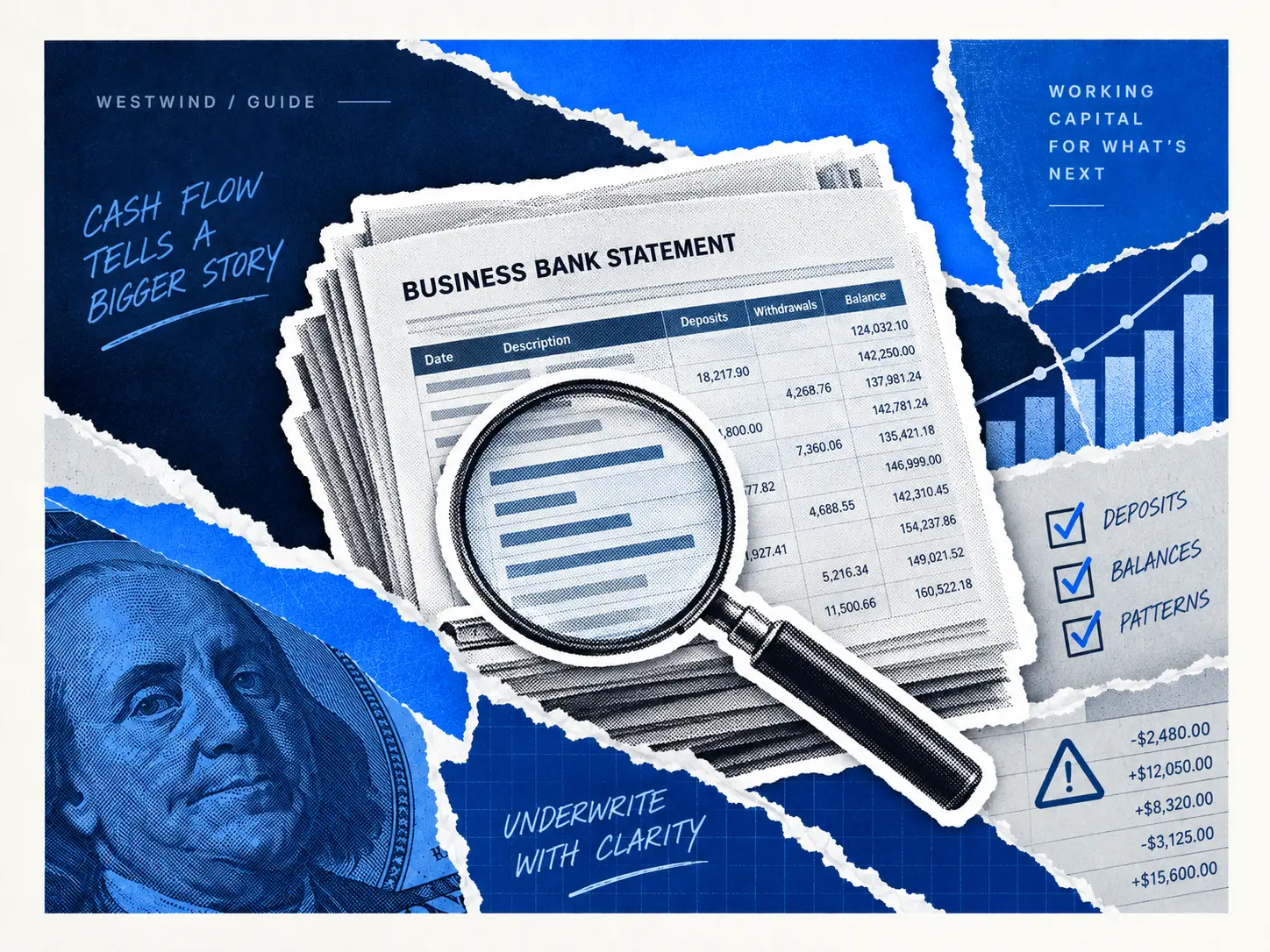
Business bank statement analysis helps lenders assess the cash your business receives, the obligations it pays, and the cushion left between those events. Lenders look beyond the closing balance. A statement can show strong deposits while also revealing frequent overdrafts, heavy debt withdrawals, or transfers that are being mistaken for revenue.
Key takeaways
- Bank deposits can include transfers, borrowed funds, and owner contributions as well as customer receipts.
- Daily balances and existing withdrawals can reveal pressure that a month-end balance misses.
- Provide complete original statements and a clear explanation of material exceptions.
The business context
The exact method varies by lender and product. The goal is usually to connect the application story to actual account activity. OnDeck, for example, explains that statements help it understand an applicant's finances before making a decision.[1]
Which bank statements lenders may request
Expect to provide complete statements for the relevant business accounts and the requested period. A lender might start with several recent months, then request a longer history to investigate seasonality or explain unusual activity. OnDeck's current FAQ identifies the last three months of business statements in its application requirements; that is one provider's process, not a rule for all financing.[2]
Provide original PDFs or use the lender's authorized bank connection. Include all pages, including pages with no transactions. If revenue flows through multiple accounts or payment processors, explain how they connect so reviewers can avoid missing or double counting money.
Deposits are not automatically business revenue
A deposit can be a customer payment, an owner contribution, a transfer between your accounts, a loan disbursement, or a refund. These entries all increase the bank balance, but they do not represent the same ability to earn and repay.
Consider this hypothetical month:
| Deposit category | Amount | How to explain it |
|---|---|---|
| Customer receipts | $92,000 | Operating cash from customers |
| Transfer from another company account | $18,000 | Movement of existing cash |
| New financing proceeds | $25,000 | Borrowed funds rather than sales |
| Owner capital contribution | $5,000 | Owner support rather than sales |
| Total bank deposits | $140,000 | Total inflows before classification |
The total is $140,000, but customer receipts are $92,000. Calling the whole amount monthly sales would overstate the operating inflow by $48,000. The underwriting treatment of each entry depends on the provider and product; prepare the explanation rather than guessing how an automated system will classify it.
Bank receipts can also differ from accounting revenue for valid reasons. Card settlements may arrive net of processing fees or refunds, while invoices may be recorded before customers pay. Reconcile these differences with processor reports and financial statements instead of forcing the totals to match artificially.[3]
Balances show how much room the business has
A month end balance is one moment in time. Average daily balance shows the average across the statement period, while the lowest balance highlights a potential pressure point. These measures answer different questions.
A business might finish the month with $30,000 after a large customer pays, yet spend two weeks with less than $2,000 available. A new daily withdrawal could be difficult during that stretch even if the ending balance looks comfortable.
Review the calendar around payroll, tax payments, supplier runs, and customer settlement dates. The pattern matters. If the account regularly runs low on the same weekday, identify the underlying mismatch and test the proposed payment against it in a cash flow forecast.
Existing payments reveal the true debt burden
Recurring ACH debits may correspond to term loans, equipment financing, capital advances, leases, or other obligations. Give the lender a complete debt schedule with provider names, balances, payment amounts, frequency, maturity, and security.
For planning, $700 withdrawn every business day is $3,500 across a five payment week. Twenty one payment days would produce $14,700 in that month. Do not multiply by a fixed number of days and assume every month is identical; use the actual payment calendar and any holiday rules in the agreement.
Disclose obligations even if they are paid from another account. A transfer that covers a debt payment elsewhere still affects the business's cash. Explain which obligations will be paid off at closing and which will remain.
If frequent withdrawals are the main problem, review when MCA refinancing or consolidation helps before assuming another advance is the answer.
What unusual transactions can mean
An overdraft, returned payment, large withdrawal, or irregular deposit usually deserves context. It does not tell the entire credit story on its own. A single returned payment caused by a documented banking error is different from repeated shortfalls with no explanation.
Prepare short factual notes for material exceptions. Include the date, amount, cause, supporting evidence, and what changed. If a customer paid late, attach the invoice and evidence of eventual collection. If an account was replaced, provide the old and new statement periods so the cash history remains continuous.
Avoid cosmetic fixes. Moving money between accounts, briefly injecting borrowed cash, or excluding an account does not improve operating repayment capacity. It can create discrepancies that make the application harder to review.
How to prepare a clear statement package
- Confirm that account names match the applying business or explain any difference.
- Provide the full requested date range with no missing pages or months.
- Identify transfers, financing proceeds, and other material noncustomer deposits.
- Reconcile processor settlements and invoiced sales with the accounting records.
- Attach an accurate debt schedule and explanations for material exceptions.
- Share sensitive records only through the agreed secure submission process.
Use the business funding document checklist to assemble the rest of the application. Good preparation makes it easier to understand the business; it does not guarantee an approval or change a lender's credit policy.
Common questions about bank statement underwriting
Can I get business funding with overdrafts?
Possibly, depending on their frequency, severity, cause, and the lender's policy. Explain them honestly. Repeated overdrafts can indicate that existing obligations already exceed the cash available at key points in the month.
Does strong revenue guarantee approval?
No. Customer receipts are only one part of the review. Costs, existing payments, ownership, credit, industry, security, and the requested structure can also affect the decision.
Can I remove transactions before sending statements?
Do not alter financial evidence to change how the business appears. Ask the provider what privacy redactions, if any, it accepts. Keep original records and use a separate explanation for unusual items.
Make the cash story easy to understand
A Westwind funding advisor can help you identify which records a prospective provider needs and discuss payment structures against your cash pattern. Bring complete statements and a debt schedule so the conversation starts with the actual business position.
Sources and review
This guide addresses US business financing. Definitions and program details draw on the cited sources. Worked examples are hypothetical teaching illustrations, not customer case studies or financing offers.
- Understanding electronic bank statements
OnDeckAccessed
A lender’s explanation of bank statements and financial assessment.
- Business financing frequently asked questions
OnDeckAccessed
This provider’s stated application requirements; not an industry-wide checklist.
- Money Smart module 7 budgeting and financial statements
Federal Deposit Insurance CorporationAccessed
FDIC education on budgets, financial statements, and the distinction between profit and cash.
Review notes and methodology
Assumptions
- Worked examples use US dollars and the assumptions stated beside each calculation.
- Example amounts, fees, and payment schedules are illustrative inputs, not quoted market terms.
Limits of the evidence
- Eligibility, pricing, and obligations vary by provider, product, jurisdiction, and agreement.
- Program rules can change. Confirm current requirements for the proposed transaction.
The site owner requested deployment of this complete guide on October 9, 2026. Source references, calculations, and internal links were checked during preparation. A named financial reviewer has not yet been recorded.
Westwind Capital is a financing intermediary. Providers determine eligibility, approval, pricing, and final terms.
Educational information, not individualized financial, legal, tax or accounting advice. Examples are not financing offers. Any actual terms and availability depend on the provider’s review and the relevant agreements.