
Understanding debt service coverage ratio
Understand the debt service coverage ratio, calculate DSCR with a worked example, and see how new payments and weaker cash flow affect borrowing capacity.
The short answer
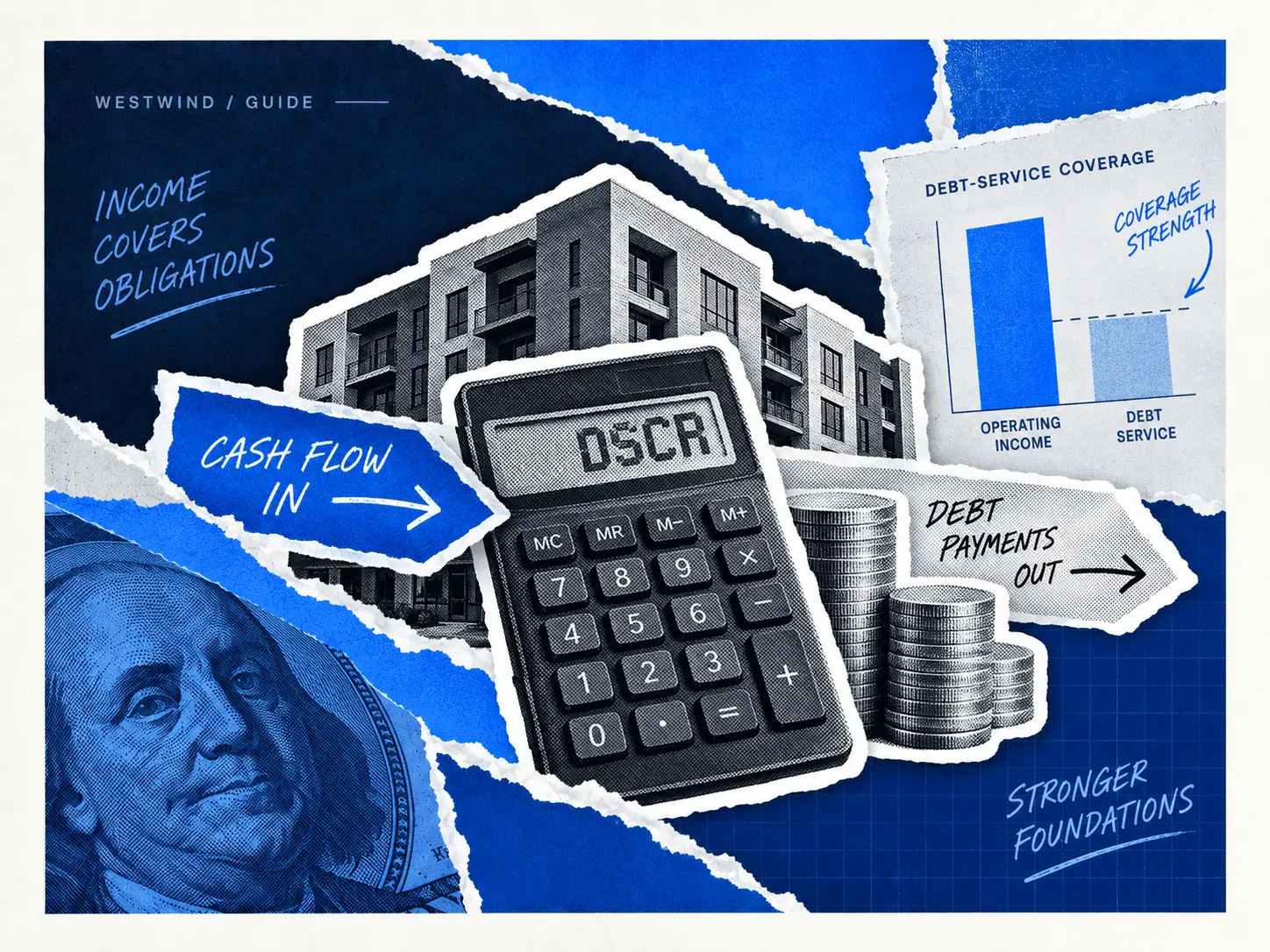
Debt service coverage ratio, or DSCR, compares a defined measure of income or cash available for debt service with the principal and interest due over the same period. A ratio above 1.00 means that measure exceeds the scheduled debt payments. The lender's definition matters because different adjustments can produce different results for the same business.
Key takeaways
- DSCR compares a defined income or cash measure with debt service for the same period.
- Include existing obligations and the proposed financing, using the lender’s actual definition.
- A strong annual ratio does not rule out a short-term cash shortage.
The business context
DSCR helps answer whether a proposed payment fits, but it does not show exactly when cash reaches the bank. Use it alongside a cash forecast, current financial statements, and the lender's stated underwriting method.
The DSCR formula
DSCR equals cash available for debt service divided by total debt service for the same period. Many explanations use net operating income as the numerator. In operating business lending, a provider may instead use adjusted earnings or another defined cash flow measure. Chase describes the basic relationship as net operating income divided by debt obligations.[1]
Debt service ordinarily includes scheduled principal and interest, not just interest expense. The loan agreement or underwriting policy determines the treatment of leases, advances, revolving facilities, related party debt, and other obligations.
Use consistent periods. Annual income divided by one month's payments gives a meaningless result. Also include the proposed financing when assessing the business after closing, rather than calculating coverage only on existing debts.
A worked DSCR calculation
Assume a lender accepts $180,000 of annual cash available for debt service after its required adjustments. Existing loans require $60,000 a year. A proposed loan adds another $60,000 a year.
| Measure | Before new financing | After new financing |
|---|---|---|
| Accepted annual cash available | $180,000 | $180,000 |
| Existing annual debt service | $60,000 | $60,000 |
| Proposed annual debt service | $0 | $60,000 |
| Total annual debt service | $60,000 | $120,000 |
| DSCR | 3.00 | 1.50 |
The new borrowing reduces coverage from 3.00 to 1.50. Under the stated definition, $1.50 is available for every $1 of debt service. The $60,000 difference is a cushion within this calculation, not automatically unrestricted distributable cash. Taxes, capital spending, or other uses omitted from the lender's numerator may still need funding.
Now reduce accepted cash flow by 20%, to $144,000. With debt service unchanged at $120,000, DSCR falls to 1.20. This sensitivity is useful because an attractive historical result can narrow quickly when operating performance weakens.
What counts as a good DSCR
There is no single approval threshold for every product. A lender may require a minimum at application, a different ongoing covenant, or a stronger result for a riskier transaction. Chase notes that banks often look for at least 1.25, but that is not a universal rule or an approval guarantee.[1]
A ratio of 1.00 leaves no cushion in the calculation. Below 1.00, the defined operating source is insufficient to cover the included debt service. The business may still make payments using cash reserves or owner support, but those sources should not be confused with recurring operating coverage.
Ask what the lender requires, which expenses it deducts, what add backs it accepts, and whether it measures historical, projected, or global coverage. Get the actual covenant definition before signing.
Why EBITDA and cash are different
Earnings before interest, taxes, depreciation, and amortization can be a starting point, but it does not capture all cash movements. Customers may pay late, inventory may need funding, taxes may be due, and equipment may require replacement.
Add backs also need evidence. A genuine one time expense may receive different treatment from a cost that recurs every year under a different label. Owner compensation cannot simply be removed if someone must continue doing the work and be paid for it.
Prepare a reconciliation from the financial statements to the proposed numerator. Show each adjustment separately and let the lender confirm what it accepts. The business funding document checklist helps organize that evidence.
How DSCR affects the payment you can support
For an initial planning exercise, divide accepted cash flow by the target coverage ratio to estimate total allowable debt service. Then subtract the obligations that will remain.
Using $180,000 and an illustrative target of 1.25, the total annual debt service budget is $144,000. Subtract $60,000 of existing debt service and $84,000 remains, equivalent to $7,000 a month. This is a mathematical planning result, not a loan approval or a recommended borrowing maximum.
The resulting loan amount still depends on interest rate, fees, amortization, maturity, and lender policy. A balloon loan may show lower scheduled installments while leaving a large maturity obligation. Include that refinancing or repayment risk in the decision.
Improve coverage through operating changes
Coverage can improve when sustainable operating earnings rise or required debt service falls. Review pricing, contribution margins, recurring costs, and the timing of planned investments. Evaluate refinancing against its total cost, not only the installment reduction.
Collections work can improve liquidity even where it does not immediately change the accounting income used in a DSCR calculation. That distinction matters: better payment timing and better reported coverage are related goals, but they are not always the same number.
Build a cash flow forecast to identify timing gaps. FDIC cash flow education emphasizes the movement of cash into and out of the business, which complements an income based ratio.[3]
Common questions about DSCR
Is DSCR the same as debt to income ratio?
No. DSCR generally divides a defined operating income or cash flow measure by debt service. A personal debt to income ratio generally divides monthly debt obligations by gross monthly income. The direction and inputs differ.
Is a business DSCR calculation the same as a property calculation?
Not necessarily. Commercial property analysis commonly uses the property's net operating income divided by annual debt service. Operating business analysis may use different adjustments. JPMorgan explains the property version in that context. Use the definition relevant to the actual financing.[2]
Can a good DSCR guarantee funding?
No. Credit, collateral, industry, ownership, documentation, and other underwriting conditions still matter. A strong annual ratio can also conceal a seasonal cash shortage.
Test the proposed payment before applying
Bring a reconciled income calculation and complete debt schedule to a Westwind funding advisor. We can help discuss payment capacity and the information a lender may request. For the wider cost comparison, read how to compare business financing offers.
Sources and review
This guide addresses US business financing. Definitions and program details draw on the cited sources. Worked examples are hypothetical teaching illustrations, not customer case studies or financing offers.
- Understanding the debt service coverage ratio
Chase for BusinessAccessed
A lender’s explanation of DSCR calculations and commonly discussed coverage levels.
- Debt service coverage ratio in real estate
JPMorganAccessed
A lender’s explanation of DSCR in commercial real-estate analysis.
- Money Smart module 10 managing cash flow
Federal Deposit Insurance CorporationAccessed
FDIC small-business education on cash receipts, payments, and cash-flow planning.
Review notes and methodology
Assumptions
- Worked examples use US dollars and the assumptions stated beside each calculation.
- Example amounts, fees, and payment schedules are illustrative inputs, not quoted market terms.
Limits of the evidence
- Eligibility, pricing, and obligations vary by provider, product, jurisdiction, and agreement.
- Program rules can change. Confirm current requirements for the proposed transaction.
The site owner requested deployment of this complete guide on October 9, 2026. Source references, calculations, and internal links were checked during preparation. A named financial reviewer has not yet been recorded.
Westwind Capital is a financing intermediary. Providers determine eligibility, approval, pricing, and final terms.
Educational information, not individualized financial, legal, tax or accounting advice. Examples are not financing offers. Any actual terms and availability depend on the provider’s review and the relevant agreements.