
Factor rates explained
Understand factor rates with clear dollar examples. See why a factor rate differs from APR and how fees, payment timing, and early payoff change the comparison.
The short answer
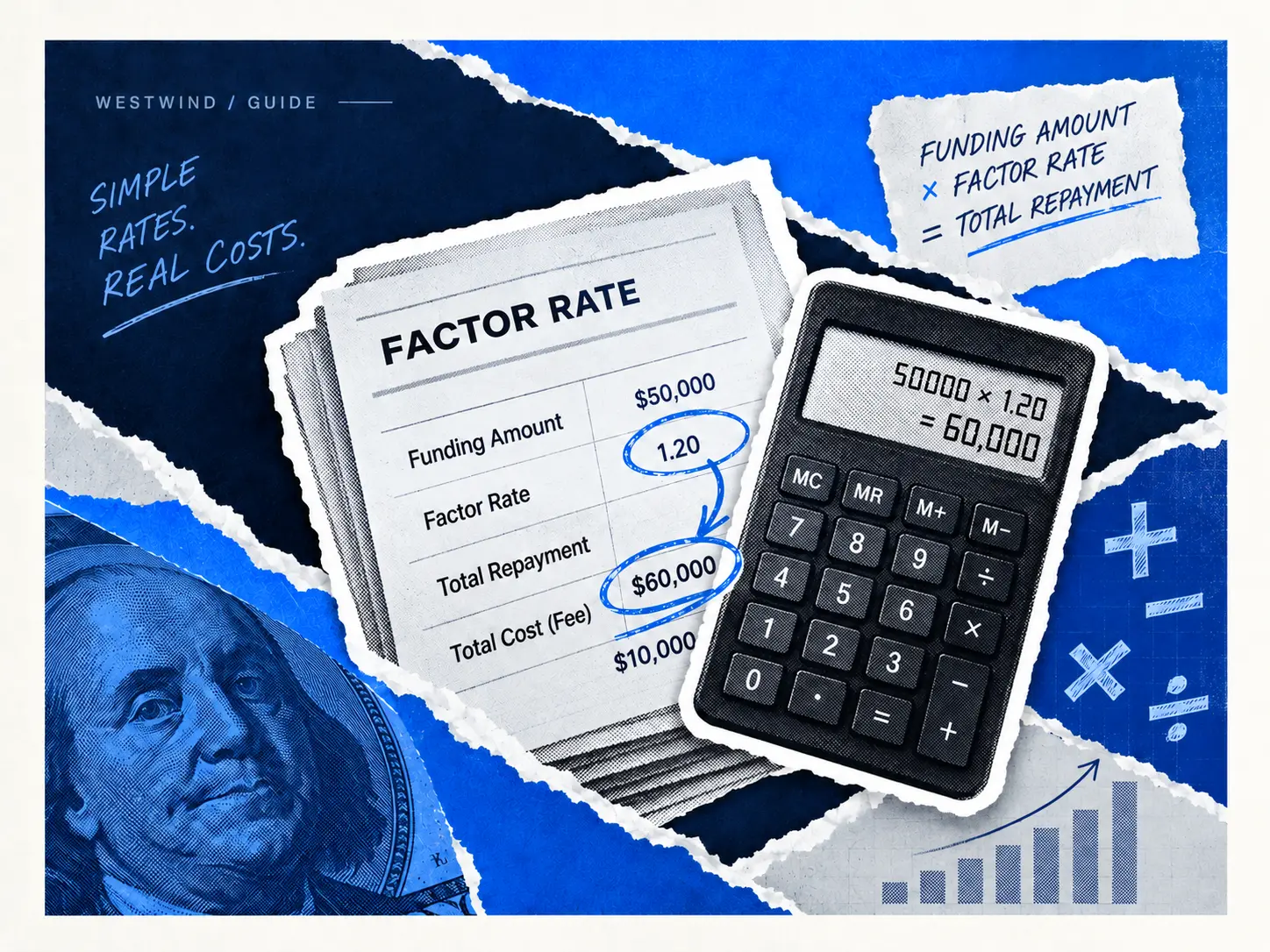
Factor rates are multipliers used to calculate a specified repayment or purchased amount from a funding amount. If $50,000 is priced at a 1.30 factor, the resulting amount is $65,000 before any separate adjustments. A factor rate does not describe annual borrowing cost and should never be read as an APR.
Key takeaways
- A factor rate multiplies a stated funding amount; it is not an APR.
- Withheld fees reduce the cash received and can increase the effective cost of the offer.
- Payment timing, revenue-share terms, and early payoff rules still need a separate review.
The business context
Factor pricing appears in some short term business financing and capital advance offers. The arithmetic is simple, but the amount you receive, the time over which you pay, and the contract's early settlement rules determine how useful that number is.
How to calculate a factor priced amount
Multiply the amount to which the factor applies by the factor rate. Then subtract that original amount to identify the pricing premium before other fees.
| Example | Calculation | Result |
|---|---|---|
| Funding amount used in pricing | Stated amount | $50,000 |
| Factor rate | Stated multiplier | 1.30 |
| Repayment or purchased amount | $50,000 multiplied by 1.30 | $65,000 |
| Pricing premium before other fees | $65,000 less $50,000 | $15,000 |
The $15,000 premium equals 30% of the stated $50,000 amount. It is not automatically a 30% annual rate. The factor calculation alone contains no information about payment dates or the declining balance as collections occur.
Confirm the amount the multiplier applies to. If a renewal includes a payoff of previous financing, the calculation may apply to the new gross transaction rather than only the fresh cash you keep.
Why fees change the amount you actually pay for
Now assume the provider withholds a $2,000 origination fee from the $50,000 disbursement. The business receives $48,000 but still owes or remits the stated $65,000 under the hypothetical agreement.
The difference between total remittances and cash received is $17,000, equivalent to about 35.42% of the $48,000 received. That is a total cash cost comparison, not an APR. It includes the withheld fee; adding the same $2,000 a second time would overstate cost.
If the contract also charges an amount separately, include it only once in the complete cash flow. Ask for an itemized funding and repayment illustration. FTC enforcement has addressed discrepancies between promised and actual funding amounts and fees, so the net disbursement deserves explicit confirmation.[3]
Factor rate versus interest rate and APR
An interest based loan typically calculates interest using a balance, rate, and time convention specified in the agreement. On a standard amortizing structure, principal repayments reduce the balance on which future interest accrues.
A factor priced agreement establishes its pricing through a multiplier. Whether the cost reduces when you pay early depends on the actual contract. You cannot infer an interest accrual method merely from a factor such as 1.20 or 1.35.
APR annualizes a financing cost using specified cash flows and calculation rules. Some commercial financing regimes prescribe disclosure methods for particular products, including estimated terms for sales based financing. New York's Part 600 is one example with a defined scope.[1]
To calculate or compare an annualized cost, you need the net amount advanced, all relevant fees, payment amounts, and payment dates. A provider's disclosed APR or estimated APR should also state the assumptions where payments are variable. OnDeck's financing comparison materials illustrate why standardized cost measures can add context beyond a headline price.[2]
The same factor can create different cash pressure
Consider two hypothetical agreements that each advance $50,000 with no withheld fees and specify $65,000 in total payments. One uses six equal monthly payments; the other uses twelve.
Six payments would average approximately $10,833.33, with a small final rounding adjustment. Twelve would average approximately $5,416.67, also subject to a final adjustment. The total premium is $15,000 in both cases, but the six month schedule returns the provider's money much faster and requires twice the monthly cash.
That faster repayment produces a higher annualized financing cost under the same consistent cash flow method. Dividing 30% by the number of months and multiplying by twelve does not properly account for installment repayments. Avoid that shortcut.
Use how to compare business financing offers to compare net funding, total cost, timing, and obligations together.
What to ask about early payoff
Ask for the dollar payoff at specific dates. Some contracts offer a defined discount within an early period; others leave much of the original amount payable. The phrase no prepayment penalty does not tell you whether the unearned financing charge is reduced. Review business loan prepayment terms for the full payoff comparison.
Compare paying early with continuing the scheduled payments, including the value of cash you would use. If you are replacing an advance, review MCA refinancing and consolidation so a lower withdrawal does not distract from a larger overall obligation.
Common questions about factor rates
Is a 1.20 factor the same as 20% interest?
It means the factor priced amount is 120% of the amount to which the multiplier applies. The 20% difference is a pricing premium before other charges. It does not establish an interest rate or an annualized rate.
Does a lower factor always mean cheaper financing?
No. Compare net cash, separate fees, payment dates, and payoff terms. A lower multiplier with faster collections and substantial fees can be more demanding or more expensive on an annualized basis.
Can I convert a factor rate to APR without a payment schedule?
Not reliably. You need cash flows and timing, and variable revenue based payments require assumptions. Ask for the relevant disclosure and an explanation of its methodology rather than relying on the multiplier alone.
Translate the offer into actual dollars
Bring the factor, gross amount, net disbursement, collection schedule, and payoff terms to a Westwind funding advisor. We can help you see what the offer means for cash flow and compare it with other available structures.
Sources and review
This guide addresses US business financing. Definitions and program details draw on the cited sources. Worked examples are hypothetical teaching illustrations, not customer case studies or financing offers.
- 23 NYCRR Part 600 commercial financing disclosures
New York Department of Financial ServicesAccessed
New York’s commercial financing disclosure regulation; applicability depends on its stated scope.
- Loan comparison and financing disclosures
OnDeckAccessed
Provider disclosures illustrating product-specific costs, payment terms, and early-payoff treatment.
- Merchant cash advance providers banned from industry
Federal Trade CommissionAccessed
FTC enforcement findings concerning representations about funding amounts, fees, and guarantees.
Review notes and methodology
Assumptions
- Worked examples use US dollars and the assumptions stated beside each calculation.
- Example amounts, fees, and payment schedules are illustrative inputs, not quoted market terms.
Limits of the evidence
- Eligibility, pricing, and obligations vary by provider, product, jurisdiction, and agreement.
- Program rules can change. Confirm current requirements for the proposed transaction.
The site owner requested deployment of this complete guide on October 9, 2026. Source references, calculations, and internal links were checked during preparation. A named financial reviewer has not yet been recorded.
Westwind Capital is a financing intermediary. Providers determine eligibility, approval, pricing, and final terms.
Educational information, not individualized financial, legal, tax or accounting advice. Examples are not financing offers. Any actual terms and availability depend on the provider’s review and the relevant agreements.